P-ISSN: 2227-3883
E-ISSN: 2707-3025

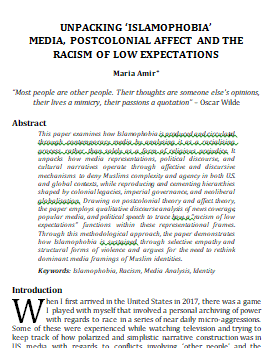
This journal issue comprises five articles providing valuable research information on key developments related to topics of national and international significance. The first article, Unpacking ‘Islamophobia’ Media, Postcolonial Affect and the Racism of Low Expectations by Maria Amir unpacks Islamophobia as a racializing process amplified by media, denying Muslims agency through selective empathy, postcolonial affect, and "racism of low expectations.” Applying discourse and affect theory on U.S. global coverage, the paper exposes structural violence exercised against Muslim in representation models, urging reframing of Muslim identities beyond terrorism stereotypes.
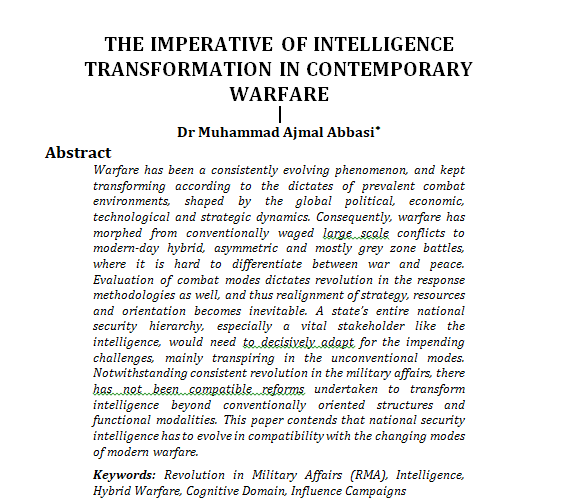
The second article, The Imperative of Intelligence Transformation in Contemporary Warfare by Dr Muhammad Ajmal Abbasi examines the urgent need for intelligence transformation amid evolving warfare—from conventional battles to hybrid, asymmetric, and grey zone conflicts. The paper critiques the lag in intelligence reforms despite revolution in military affairs, advocating adaptation to unconventional threats like cognitive operations and influence campaigns for the provision of robust national security.
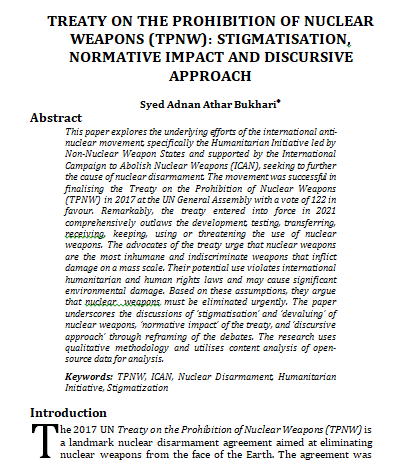
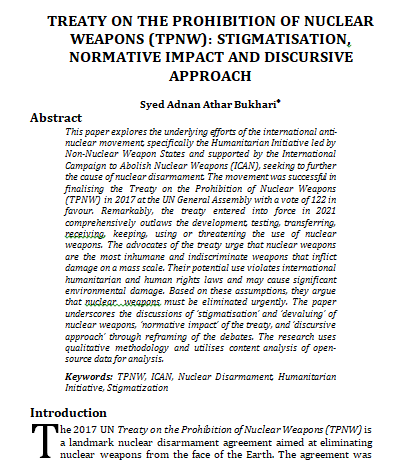
The third article, Treaty on the Prohibition of Nuclear Weapons (TPNW): Stigmatisation, Normative Impact and Discursive Approach by Syed Adnan Athar analyzes the TPNW (Treaty on the Prohibition of Nuclear Weapons), ICAN-led Humanitarian Initiative, and nuclear disarmament efforts via the lens of stigmatization, normative impact, and discursive reframing. It highlights the 2017 nuclear ban treaty's entry into force in 2021, despite the nuclear weapon states’ opposition.
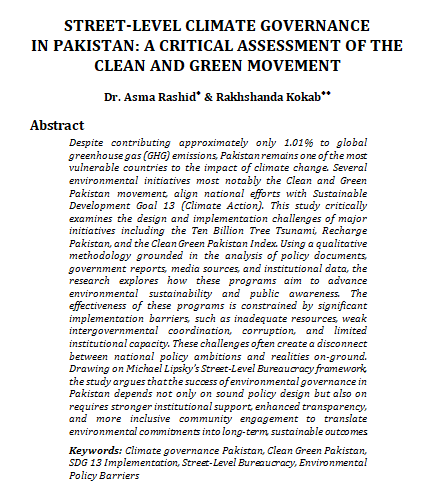
The fourth article, Street-Level Climate Governance In Pakistan: A Critical Assessment of the Clean and Green Movement by Dr. Asma Rashid and Rakhshanda Kokab critically assess Pakistan's street-level climate governance through the Clean and Green Pakistan movement, Ten Billion Tree Tsunami, and Recharge Pakistan initiatives under SDG 13. Applying Michael Lipsky's Street-Level Bureaucracy framework, the study reveals implementation gaps in resource shortages, poor coordination, corruption, and weak capacity, urging transparency and community engagement for sustainable environmental outcomes.
The last article, India’s Overtures in the Middle East: Hedging or Balancing Amid Partnerships by Ali Hamza scrutinizes India's Middle East foreign policy evolution, from non-alignment to strategic hedging amid partnerships with Saudi Arabia, Israel, and Iran. It unpacks economic interdependence, energy security, and middle power positioning, revealing New Delhi's pragmatic balancing approach to maintain strategic autonomy without entanglement in regional geopolitics.
I extend my sincere appreciation to the contributors, peer-reviewers, and the editorial team for their diligent efforts in shaping this issue. The collective work aims to enrich the discourse at national and international levels. As we navigate the complexities of interdisciplinary dialogue, we recognize the significance of fostering connections across fields. This is a humble offering to add to the current discourse.
Editor
Dr Sumeera Imran
P-ISSN: 2227-3883
E-ISSN: 2707-3025


Y Category