GLOBAL SOUTH PERSPECTIVES ON CYBER GOVERNANCE: PAKISTAN’S ADVOCACY FOR A LEGALLY BINDING ICT FRAMEWORK AT THE UN
DOI:
https://doi.org/10.54690/1mxpcf41Abstract
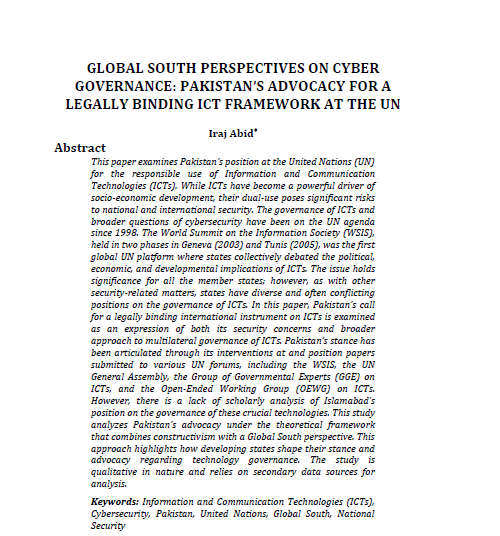
This paper examines Pakistan’s position at the United Nations (UN) for the responsible use of Information and Communication Technologies (ICTs). While ICTs have become a powerful driver of socio-economic development, their dual-use poses significant risks to national and international security. The governance of ICTs and broader questions of cybersecurity have been on the UN agenda since 1998. The World Summit on the Information Society (WSIS), held in two phases in Geneva (2003) and Tunis (2005), was the first global UN platform where states collectively debated the political, economic, and developmental implications of ICTs. The issue holds significance for all the member states; however, as with other security-related matters, states have diverse and often conflicting positions on the governance of ICTs. In this paper, Pakistan’s call for a legally binding international instrument on ICTs is examined as an expression of both its security concerns and broader approach to multilateral governance of ICTs. Pakistan’s stance has been articulated through its interventions at and position papers submitted to various UN forums, including the WSIS, the UN General Assembly, the Group of Governmental Experts (GGE) on ICTs, and the Open-Ended Working Group (OEWG) on ICTs. However, there is a lack of scholarly analysis of Islamabad’s position on the governance of these crucial technologies. This study analyzes Pakistan’s advocacy under the theoretical framework that combines constructivism with a Global South perspective. This approach highlights how developing states shape their stance and advocacy regarding technology governance. The study is qualitative in nature and relies on secondary data sources for analysis.
Downloads
Published
Issue
Section
License
Copyright (c) 2026 Journal of Contemporary Studies

This work is licensed under a Creative Commons Attribution-NonCommercial 4.0 International License.
Authors publishing with the Journal of Contemporary Studies (JCS) retain full copyright and publishing rights to their work without restriction. Articles are licensed under the Creative Commons Attribution 4.0 International License (CC BY 4.0), permitting unrestricted use, distribution, and reproduction in any medium, provided the original work is properly cited.