P-ISSN: 2227-3883
E-ISSN: 2707-3025

The Journal of Contemporary Studies is a flagship publication of the Faculty of Contemporary Studies (FCS), National Defence University (NDU), Islamabad. The journal offers scholarly analyses on contemporary issues related to international relations, traditional and non-traditional security and contributes to policy debates on topics of global governance.
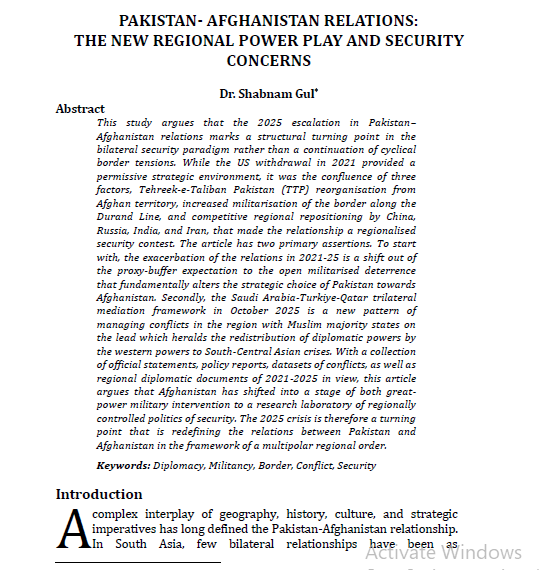
This journal issue comprises five articles providing valuable research information on key developments related to topics of national and international significance. The first article, Pakistan-Afghanistan Relations: The New Regional Power Play and Security Concerns by Prof. Dr. Shabnam Gul posits that the 2025 Pakistan–Afghanistan escalation represents a structural shift from historical proxy dynamics to a state of open militarized deterrence within a multipolar regional order. It highlights how the convergence of militant reorganization and border militarization has transformed bilateral tensions into a regionalized security contest.
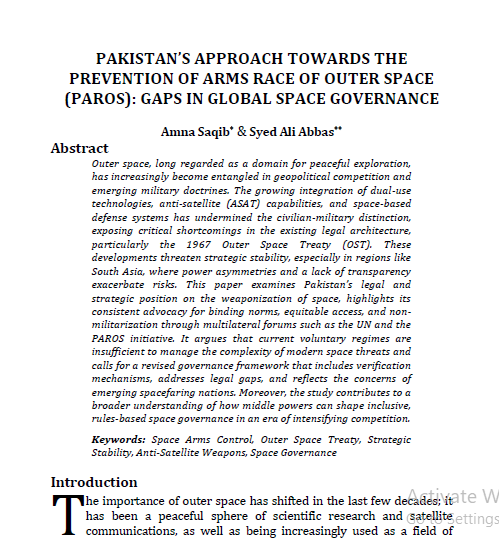
The second article, Pakistan’s Approach to the Prevention of Arms Race of Outer Space: Gaps in Global Space Governance by Amna Saqib and Syed Ali Abbas examines the escalating militarization of outer space and the subsequent obsolescence of the 1967 Outer Space Treaty in the face of modern dual-use technologies and ASAT capabilities. It analyzes Pakistan’s strategic advocacy for the PAROS initiative and legally binding non-weaponization norms as a response to regional power asymmetries and the inadequacy of current voluntary governance. Ultimately, the article argues for a revised, inclusive legal framework featuring robust verification mechanisms to safeguard the interests of middle powers and maintain strategic stability in a multipolar era.
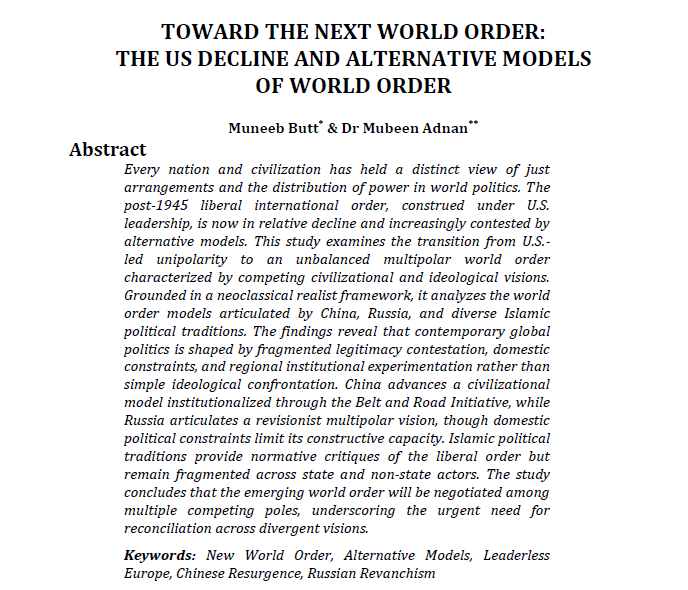
The third article, Toward the Next World Order: The US Decline and Alternative Models of World Order by Muneeb Butt and Dr Mubeen Adnan This study examines the transition from U.S.-led unipolarity to a fragmented, unbalanced multipolar order characterized by competing civilizational and ideological visions from China, Russia, and the Islamic world. Utilizing a neoclassical realist framework, it argues that global politics is currently defined by regional institutional experimentation and legitimacy contestation rather than a singular ideological confrontation. The findings conclude that the future global order will be a negotiated reality among multiple poles, necessitating a reconciliation of divergent normative and strategic models.
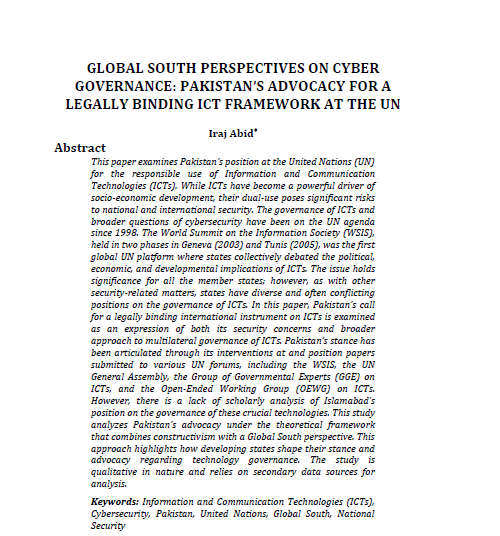
The fourth article, Global South Perspectives on Cyber Governance: Pakistan’s Advocacy for a Legally Binding ICT Framework at the UN by Iraj Abid analyzes Pakistan’s advocacy for a legally binding international instrument to govern the dual-use risks of Information and Communication Technologies (ICTs) within various UN forums. Utilizing a framework that combines constructivism with a Global South perspective, it explores how Islamabad’s position reflects both its national security concerns and its broader commitment to multilateral technology governance. The study addresses a scholarly gap by scrutinizing Pakistan’s diplomatic interventions as a representative effort by a developing state to shape inclusive, rules-based norms for global cybersecurity.
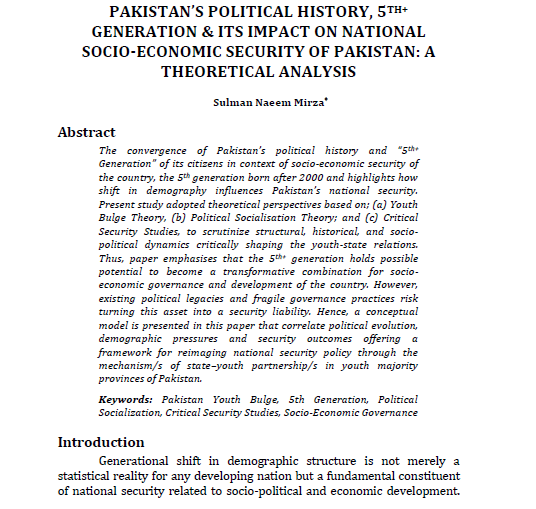
The last article, Pakistan’s Political History, 5th+ Generation & its Impact on National Socio-Economic Security of Pakistan: A Theoretical Analysis by Dr Sulman Naeem Mirza analyzes Pakistan’s 5th Generation(post-2000) using Youth Bulge and Political Socialization theories to assess its impact on national security. It argues that while this demographic offers transformative potential, fragile governance risk turning it into a security liability. The paper proposes a conceptual model for reimagining security through formalized state-youth partnerships in youth-majority provinces.
P-ISSN: 2227-3883
E-ISSN: 2707-3025


Y Category