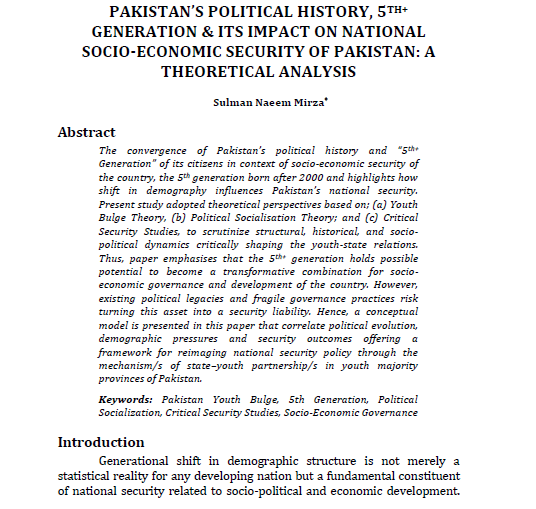
PAKISTAN’S POLITICAL HISTORY, 5TH+ GENERATION & ITS IMPACT ON NATIONAL SOCIO-ECONOMIC SECURITY OF PAKISTAN: A THEORETICAL ANALYSIS
DOI:
https://doi.org/10.54690/pcs6db81Keywords:
Pakistan Youth Bulge, Political Socialization, Socio-Economic Governance, Critical Security Studies, 5th GenerationAbstract
The convergence of Pakistan’s political history and “5th+ Generation” of its citizens in context of socio-economic security of the country, the 5th generation born after 2000 and highlights how shift in demography influences Pakistan’s national security. Present study adopted theoretical perspectives based on; (a) Youth Bulge Theory, (b) Political Socialisation Theory; and (c) Critical Security Studies, to scrutinize structural, historical, and sociopolitical dynamics critically shaping the youth-state relations. Thus, the paper's emphasis is that the 5th+ generation holds possible potential to become a transformative combination for socioeconomic governance and development of the country. However, existing political legacies and fragile governance practices risk turning this asset into a security liability. Hence, a conceptual model is presented in this paper that correlate political evolution, demographic pressures and security outcomes offering a framework for reimaging national security policy through the mechanism/s of state–youth partnership/s in youth majority provinces of Pakistan.
Downloads
Published
Issue
Section
License
Copyright (c) 2026 Journal of Contemporary Studies

This work is licensed under a Creative Commons Attribution-NonCommercial 4.0 International License.
Authors publishing with the Journal of Contemporary Studies (JCS) retain full copyright and publishing rights to their work without restriction. Articles are licensed under the Creative Commons Attribution 4.0 International License (CC BY 4.0), permitting unrestricted use, distribution, and reproduction in any medium, provided the original work is properly cited.