POST SOLEIMANI US IRAN TENSIONS CONSEQUENCES AND RESPONSES
DOI:
https://doi.org/10.54690/jcs.v9iII.54Keywords:
Iran, US, Iraq, NPT, WMD, JCPOA, Daesh, Soleimani, IRGC-QF, FATFAbstract
Abstract
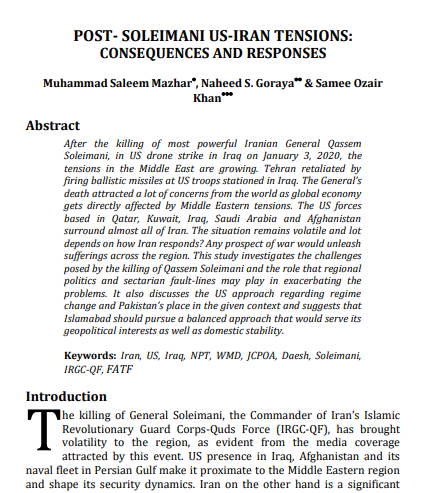
After the killing of most powerful Iranian General Qassem Soleimani, in US drone strike in Iraq on January 3, 2020, the
tensions in the Middle East are growing. Tehran retaliated by firing ballistic missiles at US troops stationed in Iraq. The General’s death attracted a lot of concerns from the world as global economy gets directly affected by Middle Eastern tensions. The US forces based in Qatar, Kuwait, Iraq, Saudi Arabia and Afghanistan surround almost all of Iran. The situation remains volatile and lot depends on how Iran responds? Any prospect of war would unleash sufferings across the region. This study investigates the challenges posed by the killing of Qassem Soleimani and the role that regional politics and sectarian fault-lines may play in exacerbating the problems. It also discusses the US approach regarding regime change and Pakistan’s place in the given context and suggests that Islamabad should pursue a balanced approach that would serve its geopolitical interests as well as domestic stability
Downloads
Published
Issue
Section
License
Copyright (c) 2020 Journal of Contemporary Studies

This work is licensed under a Creative Commons Attribution-NonCommercial 4.0 International License.
Authors publishing with the Journal of Contemporary Studies (JCS) retain full copyright and publishing rights to their work without restriction. Articles are licensed under the Creative Commons Attribution 4.0 International License (CC BY 4.0), permitting unrestricted use, distribution, and reproduction in any medium, provided the original work is properly cited.