TRANSITION IN WORLD ORDER AN ECLECTIC INQUIRY
DOI:
https://doi.org/10.54690/jcs.v9i1.19Keywords:
Eclecticism, World Order, Trends, Status quo, RevisionistAbstract
Abstract
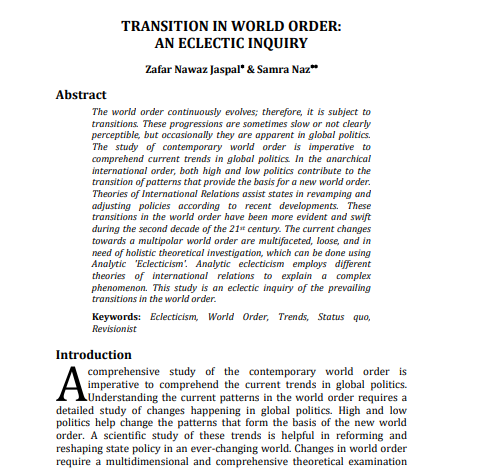
The world order continuously evolves; therefore, it is subject to transitions. These progressions are sometimes slow or not clearly perceptible, but occasionally they apparent in global politics. The study of contemporary world order is imperative to comprehend current trends in global politics. In the anarchical international order, both high and low politics contribute to the transition of patterns that provide the basis for a new world order. Theories of International Relations assist states in revamping and adjusting policies according to recent developments. These transitions in the world order have been more evident and swift during the second decade of the 21st century. The current changes towards a multipolar world order are multifaceted, loose, and in need of holistic theoretical investigation, which can be done using Analytic 'Eclecticism'. Analytic eclecticism employs different theories of international relations to explain a complex phenomenon. This study is an eclectic inquiry of the prevailing transitions in the world order.
Downloads
Published
Issue
Section
License
Authors publishing with the Journal of Contemporary Studies (JCS) retain full copyright and publishing rights to their work without restriction. Articles are licensed under the Creative Commons Attribution 4.0 International License (CC BY 4.0), permitting unrestricted use, distribution, and reproduction in any medium, provided the original work is properly cited.